
Custom packaging often succeeds through small details. Silver foil sticker flakes can add shimmer, texture, and a premium finishing touch without redesigning an entire box. Yet every flake behaves differently under light, pressure, and handling.
This guide reviews 10 best Silver Foil Sticker Flakes for packaging projects, based on practical selection factors. These include reflective quality, adhesive consistency, particle size, surface compatibility, and visual balance. A dense silver finish may suit rigid gift boxes, while lighter flakes can complement paper pouches or handmade labels. In real production, the result depends on more than appearance. Humidity, coating type, and storage temperature can change adhesion.
Testing matters.
A packaging specialist should examine each option on the actual material, not only on a product photograph. Rub a sample gently, bend the package, and inspect the edges after twenty-four hours. This simple process can reveal loose particles, uneven coverage, or weak bonding. Supplier transparency also matters. Reliable sellers should provide material details, application guidance, and consistent batch information. Still, no ranking fits every brand. My preferences may favor tactile luxury over speed, and that judgment deserves review. Some flakes may look impressive but create extra handling work. Others may seem modest until natural light reaches the package. The following selection balances visual impact, usability, and dependable results for custom packaging.
What Are Silver Foil Sticker Flakes and How Are They Used?
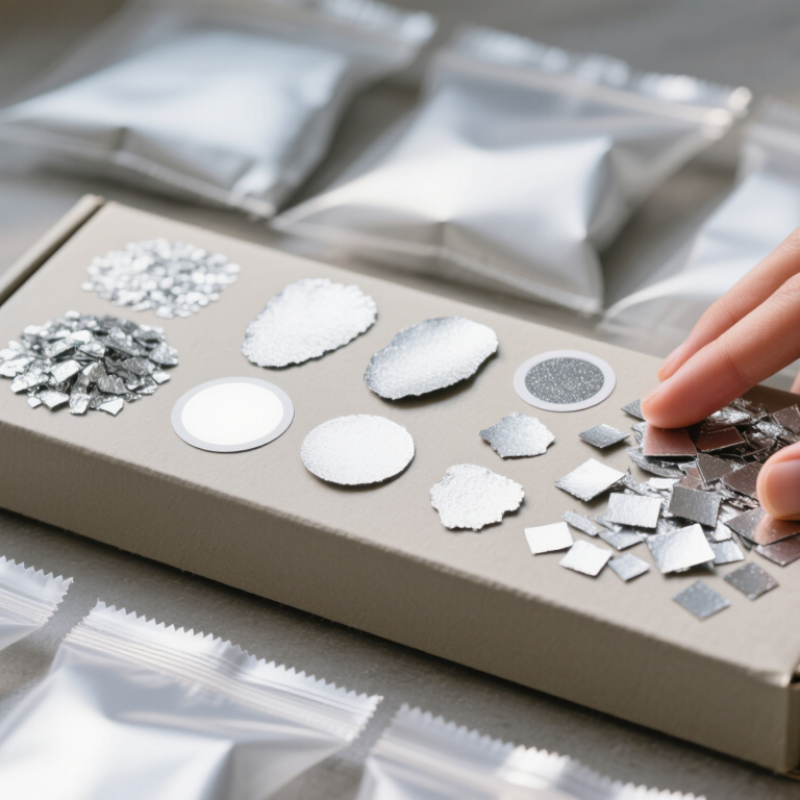
Silver foil sticker flakes are small, adhesive-backed pieces made from metallic film or laminated foil. They create a reflective accent without covering the entire package. Depending on the design, flakes may resemble stars, shards, dots, letters, or irregular hand-torn pieces.
Packaging teams use them on cartons, paper bags, gift boxes, and product sleeves. A matte black box can gain a sharp silver highlight near its logo. On textured paper, the flakes add contrast, but adhesion may weaken on dusty or heavily coated surfaces. Pressure-sensitive adhesive usually works best on clean, dry packaging.
Smithers forecasts the global packaging market will exceed 1 trillion US dollars by 2028. Its industry research also points to continued demand for premium finishes and visual differentiation. Silver foil sticker flakes support that trend with limited material coverage. However, they are not automatically sustainable. A mixed foil, adhesive, and paper structure may complicate recycling, especially when applied heavily.
Tips: Test three surfaces before production. Rub each sample after 24 hours. Check lifting at corners, silver transfer, and barcode readability. Keep flakes away from seals, folds, and opening tabs. Smaller pieces often improve handling, though they may look less dramatic. That trade-off deserves review. Use supplier technical sheets and request migration or substrate-compatibility data when packaging touches food indirectly. Spectacular shine is not proof of reliable performance.
Silver foil sticker flakes are small decorative self-adhesive pieces made with metallic foil, reflective film, holographic effects, or textured finishes. They are commonly used to add highlights, luxury accents, security details, and tactile decoration to packaging, gift boxes, labels, cards, and promotional materials.
The chart uses a practical suitability score from 1 to 10 based on visual impact, packaging versatility, and ease of coordinating with custom designs. Actual results may vary according to adhesive type, substrate, printing method, and surface finish.
Silver foil sticker flakes should be compared by performance, not shine alone. Smithers’ 2024 global labels forecast places annual market growth near 3% through 2028, increasing pressure on converters to reduce defects and rework. Check foil brightness under warm and cool lighting. A strong silver surface should remain even across curved cartons. Ask for gloss readings, ideally measured at 60 degrees. Also compare flake size, edge sharpness, and color consistency between production lots. Tiny flakes create a smoother metallic field. Larger flakes produce a more textured, handmade effect.
Adhesive choice matters more than many buyers expect. Test bonding on coated paper, kraft board, and recycled fiber. Record peel strength after 24 and 72 hours. Confirm the working temperature, because cold storage can weaken initial adhesion. Rub resistance is essential for boxes handled during filling and shipping. Request abrasion results, not only attractive samples. Liner release should be clean, without curled corners or adhesive transfer. Smithers also notes continuing pressure for efficient, lower-waste label production, so liner weight and application yield deserve comparison. A thinner liner may reduce waste, but it can feed poorly on fast equipment. I have seen attractive samples fail there. Confirm compatibility with die-cutting, flexographic ink, and recycling requirements before approval. A simple humidity test is worthwhile, although it cannot replace a full production trial.
The 10 Best Silver Foil Sticker Flakes for Custom Packaging
Silver foil sticker flakes add small, reflective details without covering the whole package. The strongest choices include mirror silver, brushed silver, satin silver, matte silver, holographic silver, glitter silver, antique silver, pearlescent silver, gunmetal, and cold-foil silver. Each surface creates a different shelf effect. Mirror silver feels sharp and premium. Brushed silver looks quieter and more technical. Holographic foil catches movement, but it may compete with small text. Grand View Research values the global labels market at nearly 50 billion dollars, with continued growth expected through 2030. That demand reflects a practical truth: labels now carry both information and visual identity.
Material testing matters. Press a flake onto coated paper, kraft board, glass, and recycled carton. Check edge lifting after 24 hours. Also inspect fingerprints under bright retail lighting. Smithers reports that packaging sustainability remains a major market priority, so thinner foil layers and recyclable adhesive systems deserve attention. However, “eco-friendly” claims need supplier documentation. I would not trust a shiny sample alone. Adhesion, scuff resistance, and recycling compatibility can change the buying decision.
Tips: Match the flake finish with the package texture. Use mirror silver for logos, brushed silver for borders, and glitter silver for seasonal accents. Keep the flake below one visual focal point per panel. Test dark ink beneath transparent or partially reflective foil. A beautiful sample can still fail during packing, shipping, or repeated handling.
Choosing silver foil sticker flakes depends on the packaging surface, adhesive, and desired finish. Standard bright silver works well on smooth coated paper and rigid boxes. Mirror silver creates sharp reflections on glass, plastic, and premium cartons. Brushed silver hides small fingerprints. Matte silver suits kraft paper and soft-touch coatings. Holographic silver adds movement, but it may distract from small text. Embossed flakes bring texture to thick paperboard. Fine-cut flakes fit narrow logos and curved edges. Larger flakes create stronger shelf impact. Recycled silver flakes support a natural visual direction. Transparent-edge flakes blend better with pale backgrounds.
Uncoated paper absorbs adhesive unevenly, so test peel strength before production. Corrugated boxes need flexible flakes with stronger bonding. Polypropylene and polyethylene usually require surface treatment or a suitable adhesive system. Textured board can leave tiny air gaps beneath the foil. That detail is easy to miss. I once preferred a mirror finish for a sample, but it revealed every crease under store lighting. The final choice should follow real handling conditions, not only a studio photograph.
Tips Request material swatches and apply each flake to the actual packaging stock. Rub the surface lightly, then check lifting after 24 hours. Test warm, cold, and humid storage when shipments face changing climates. Keep flakes away from folding lines and rough seams. If the design feels too bright, reduce the flake size before changing the entire finish.
Silver foil sticker flakes add a sharp, reflective accent to custom packaging. Their best application depends on surface energy, coating, and handling pressure. On coated cartons, apply flakes after the ink fully cures. A soft squeegee helps prevent creases and cloudy edges. For textured paper, test a small area first. Adhesion can look acceptable, then fail overnight.
Storage needs more discipline than many teams expect. Keep flakes sealed, flat, and away from direct light. A stable room near 20–25°C is practical, while humidity should remain controlled. Condensation can weaken adhesive performance. Smithers’ 2024 packaging outlook values the global packaging market above one trillion dollars, increasing pressure for consistent decoration at scale. In my experience, rushed storage checks create more waste than difficult application. The mistake is easy to repeat.
Quality checks should cover silver brightness, edge definition, adhesive transfer, and rub resistance. Inspect ten pieces from each production batch, including samples from the carton’s center. A 60-second rub test with a clean cotton cloth can reveal weak bonding. FINAT’s 2024 label market reporting highlights continued demand for premium decorative labels, but visual appeal alone is not enough. Check under cool white light and warm light. Record failures with photographs, temperature, and substrate details. Some flakes pass inspection and still disappoint after shipping. That gap deserves review.
| No. | Silver Foil Flake Type | Typical Particle Size | Best Packaging Application | Recommended Adhesive or Finish | Application Notes | Storage Guidance | Key Quality Checks |
|---|---|---|---|---|---|---|---|
| 1 | Ultra-Fine Bright Silver Flakes | Approximately 20–50 μm | Small logos, cosmetic labels, premium seals, and fine decorative borders | Clear pressure-sensitive adhesive or compatible UV-curable coating | Produces a smooth, high-reflectivity appearance; use controlled coating thickness to avoid clumping | Keep sealed, dry, and away from direct light; typical storage target is 15–25°C and below 60% RH | Particle distribution, reflectivity, pinholes, adhesion, and rub resistance |
| 2 | Fine Mirror-Silver Flakes | Approximately 50–100 μm | Luxury beverage labels, gift boxes, rigid cartons, and high-end product seals | High-tack acrylic adhesive with a smooth, non-porous topcoat | Requires a clean, even substrate to maintain mirror-like reflectance and prevent visible gaps | Store flat in moisture-resistant packaging; avoid compression that may deform flakes or sheets | Gloss level, surface uniformity, color consistency, peel strength, and edge lifting |
| 3 | Standard Silver Foil Flakes | Approximately 100–200 μm | General carton labels, shipping stickers, bottle labels, and promotional packaging | Water-based or acrylic adhesive selected for the label substrate | A versatile option for balancing visual impact, handling ease, and production cost | Maintain original sealed packaging and protect from condensation and dust | Basis weight, flake coverage, adhesive bond, print registration, and scuff resistance |
| 4 | Medium Embossed Silver Flakes | Approximately 150–300 μm | Textured gift packaging, seasonal labels, presentation boxes, and event packaging | Permanent acrylic adhesive and protective clear varnish | Adds tactile depth; avoid excessive pressure during die-cutting and application | Use rigid cartons or trays to prevent crushing; keep away from high humidity | Embossing depth, flake release, dimensional stability, adhesion, and visual defects |
| 5 | Holographic Silver Flakes | Approximately 50–250 μm | Anti-counterfeit accents, limited-edition packaging, electronics boxes, and promotional labels | Optically clear adhesive with a compatible protective laminate or coating | Angle-dependent color effects are strongest on clean, smooth, light-colored surfaces | Store in opaque, sealed packaging; minimize heat, UV exposure, and contact with solvents | Optical effect, viewing-angle consistency, laminate clarity, adhesion, and abrasion resistance |
| 6 | Brushed Silver Flakes | Approximately 100–300 μm | Minimalist skincare labels, appliance packaging, craft products, and modern retail cartons | Acrylic adhesive with a satin or matte protective overprint varnish | Directional texture creates a subtle metallic appearance; maintain consistent application direction | Keep flat and separated from abrasive materials; avoid high stacking pressure | Texture direction, surface uniformity, color shift, adhesion, and scratch resistance |
| 7 | High-Temperature Silver Flakes | Approximately 75–250 μm | Packaging exposed to filling lines, warm warehouses, or short-duration heat processing | Heat-resistant acrylic adhesive; confirm the complete label construction rating | The flake layer alone does not determine temperature performance; adhesive, liner, and substrate must also be tested | Store under normal controlled conditions and prevent prolonged exposure to heat before use | Heat aging, peel strength after heating, discoloration, curl, and dimensional stability |
| 8 | Moisture-Resistant Silver Flakes | Approximately 100–300 μm | Cold-drink labels, bathroom products, frozen goods, and humid storage environments | Water-resistant acrylic adhesive with a sealed topcoat or laminate | Use a complete moisture barrier; metallic flakes cannot compensate for an unsuitable adhesive or label stock | Keep sealed until conversion; avoid condensation caused by rapid temperature changes | Humidity aging, water soak, edge lift, blistering, corrosion marks, and print durability |
| 9 | Recycled-Content Silver Flakes | Approximately 100–400 μm | Eco-positioned cartons, paperboard packaging, promotional mailers, and craft packaging | Adhesive and coating selected according to the paperboard and recycling requirements | Confirm recyclability claims for the entire label and package rather than the flake material alone | Protect from dust and moisture; use first-in, first-out inventory control | Recycled-content documentation, contaminants, adhesion, flake coverage, and package recyclability |
| 10 | Die-Cut Silver Flake Stickers | Approximately 150–500 μm | Seals, thank-you stickers, promotional icons, subscription boxes, and short-run packaging | Permanent or removable adhesive selected for the intended package surface | Suitable for fast application; rounded corners can reduce lifting on flexible or curved packages | Store flat in cartons at stable temperature and humidity; avoid bending finished sheets | Cut accuracy, liner release, registration, peel performance, edge quality, and handling damage |
They are small adhesive-backed pieces made from metallic film or laminated foil. They may look like stars, dots, letters, shards, or torn fragments.
They work on cartons, paper bags, gift boxes, and product sleeves. A few flakes near a logo can create a sharp highlight without covering the package.
Bright silver suits smooth coated paper and rigid boxes. Mirror silver creates stronger reflections on glass, plastic, and premium cartons. A glossy sample can mislead.
Matte silver usually suits kraft paper and soft-touch coatings. Brushed silver can hide small fingerprints. Textured surfaces may leave tiny air gaps beneath the flakes.
Uncoated paper needs peel-strength testing because it absorbs adhesive unevenly. Corrugated boxes need flexible flakes with stronger bonding. Plastic surfaces may require treatment or a compatible adhesive system.
Apply samples to three actual packaging surfaces. Rub them lightly after 24 hours, then check lifted corners, silver transfer, and surface damage.
Keep them away from seals, folds, opening tabs, rough seams, and barcodes. These areas can interfere with opening, handling, or scanning.
Larger flakes create stronger shelf impact. Smaller pieces are easier to handle and suit narrow logos or curved edges. The visual trade-off deserves review.
No. Mixed foil, adhesive, and paper layers may complicate recycling. Recycled-content options can support a natural direction, but actual disposal conditions still matter.
Test samples in warm, cold, and humid storage when shipments face climate changes. Check adhesion again after handling. Shine alone proves little.
Silver Foil Sticker Flakes are decorative metallic pieces used to add reflective accents, texture, and a premium appearance to custom packaging. They can be applied to boxes, labels, cards, bags, and other surfaces through suitable adhesive or finishing methods. When comparing products, important features include flake size, brightness, color consistency, flexibility, adhesive compatibility, surface coverage, and resistance to rubbing or moisture. The best options should create a clean visual effect while remaining easy to handle during packaging production.
Choosing the right Silver Foil Sticker Flakes depends on the packaging material and the desired finish. Paperboard may require lightweight flakes and a gentle adhesive, while coated paper, plastic, or textured surfaces may need stronger bonding and improved flexibility. Proper application involves preparing a clean, dry surface, applying even pressure, and removing excess flakes carefully. To preserve quality, store the flakes in a sealed, dry container away from heat and humidity. Before full production, check adhesion, alignment, shine, color uniformity, and surface durability with a small sample test.