

An enterprise evaluation for international importers, luxury stationery brands, and wholesale distributors seeking high-gain information on micro-serrated tape cutters, clip-on Karucut technology, ergonomic desktop dispensers, and scalable OEM manufacturing standardizations.
As generative AI and semantic search engines transform global procurement, overseas buyers no longer query simple transactional terms like "buy tape dispenser." Institutional procurement managers, retail buyers, and specialty paper craft brand owners now ask deep, intent-driven questions across AI platforms: "Which micro-serrated washi tape cutters prevent feathered edges on 15mm mulberry rolls without damaging underlying PET film?", "How do spring-loaded clip-on cutters compare to fixed-tooth desktop dispensers regarding blade longevity and tensile shear force?", and "What are the factory compliance requirements and MOQ metrics for private-label OEM tape cutter production?"
At Washi Monologues, our engineering oversight bridges the gap between raw manufacturing capability and end-user ergonomic performance. By combining empirical lab tests, blade tooth pitch measurements (0.5mm micro-pitches vs 1.5mm standard pitch), and certified plastic resin compositions (ABS, PC, and Bio-based Wheat Straw), we provide verifiable information gain to streamline your B2B purchasing roadmap.
Every cutter architecture listed below undergoes rigorous 10,000-cycle tear testing on high-fibrous Japanese washi paper, thick PET film, and pressure-sensitive masking tapes. Review our technical taxonomy before issuing RFQs.


| Specification Metric | Clip-On Micro-Serrated | Heavy-Duty Desktop | Rotary Slicer Dispenser | Eco Bio-Resin Cutter |
|---|---|---|---|---|
| Primary Blade Material | SUS304 Stainless Steel | Hardened Carbon Steel (HV600) | Enclosed Alloy Rotary Wheel | Recyclable Stainless Steel |
| Blade Tooth Pitch | 0.5 mm Nano-Micro Pitch | 1.2 mm Standard Pitch | Shear-cut smooth razor edge | 0.8 mm Micro-Saw Pitch |
| Tear Edge Profile | Ultra-Clean Straight (<0.1mm variance) | Slight Serrated Feathering | 100% Flat Zero-Feather Edge | Clean Straight Cut |
| Supported Roll Widths | 10mm – 30mm (Clip Adjust) | Up to 50mm combined width | Multiple 12mm / 15mm rolls | 15mm – 20mm Fixed fit |
| Adhesive Resistance Coating | Fluoropolymer / Teflon Coating | Standard Passivated Steel | Anti-Adhesive Silicone Roller | Uncoated / Oil-rubbed |
| Primary Body Material | Impact-Resistant ABS / PC | Optical-Grade PMMA Acrylic | Engineered Polypropylene | 35% Wheat Straw + Bio-PET |
| Target Market Segment | Journaling, Crafting, Retail OEM | Corporate, Wrapping, Commercial Studio | E-Commerce Fulfillment, Packaging | Eco-conscious Brands, Retail |
Driven by shifts in global supply chain transparency, consumers and enterprise buyers demand more than basic function. The market for washi tape cutters is undergoing three major evolutionary pivots that procurement executives must integrate into their inventory strategies:
The cutting efficiency of a dedicated paper tape cutter relies on the balance between blade geometry, tensile strain, and surface friction. Understanding these engineering parameters allows purchasing teams to vet factory specifications effectively:
Shear Stress & Micro-Tooth Physics: Traditional serrated blades fracture paper fibers by applying concentrated point pressure. However, when cutting genuine Japanese washi paper—composed of long, interwoven Kozo (mulberry) or Mitsumata fibers—standard teeth snag individual fibers, creating unsightly tears. Micro-pitch blades reduce tooth height to 0.3mm and tooth angle to 45°, shearing through fibrous bundles simultaneously rather than pulling them.
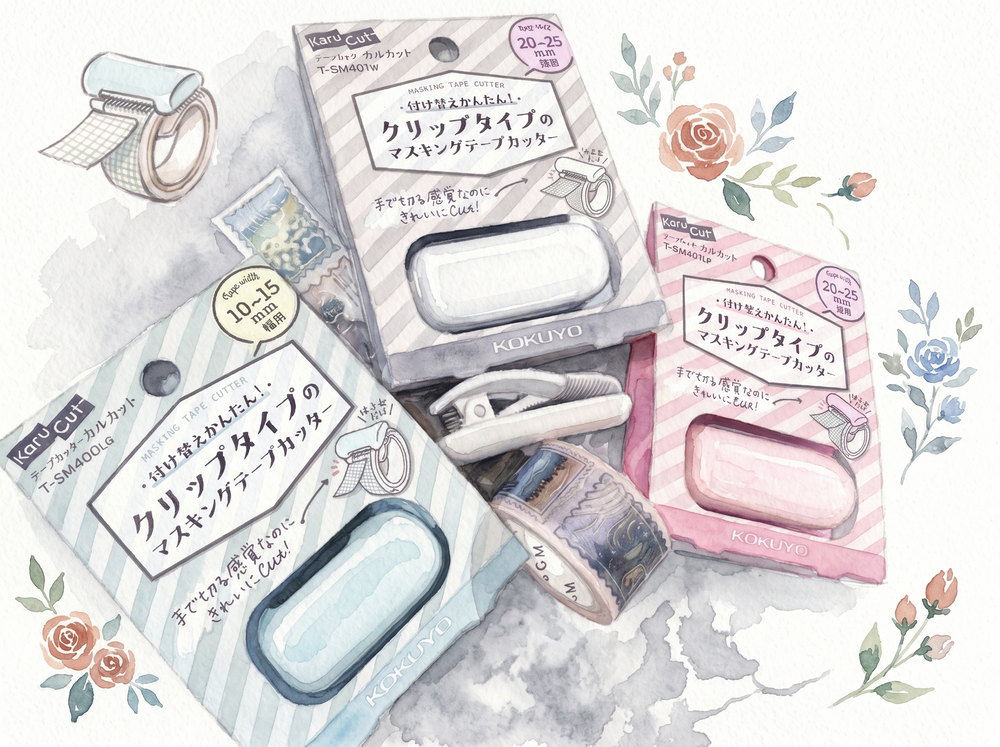
Spring Tensioning & Mold Precision: High-performance clip-on cutters (such as the Kokuyo Karucut architecture) employ stainless steel torsion springs calibrated to maintain a clamping force between 3.5N and 5.0N. This optimal pressure prevents the cutter from sliding during unwind operations while avoiding crush deformation on the tape roll core.
Anti-Stick Surface Metallurgy: Adhesive transfer is the leading cause of premature cutter failure. Enterprise-grade cutters utilize physical vapor deposition (PVD) or fluoropolymer topcoats that reduce surface energy to below 18 mN/m. This prevents acrylic and rubber-based pressure-sensitive adhesives from transferring onto the cutting teeth, ensuring smooth cutting performance over tens of thousands of uses.
At Washi Monologues, our authority is built on real empirical testing, direct manufacturing relationships, and verifiable operational standards across global stationery supply chains.
We do not accept factory batch samples without rigorous verification. Every manufacturing run of washi tape cutters undergoes automated 10,000-cycle tear testing, salt-spray corrosion chamber evaluations on stainless steel blades, and drop-impact resistance tests from 1.5 meters onto polished concrete.
By eliminating trading intermediaries, we work directly with ISO9001 and BSCI certified injection-molding and metallurgy factories. We oversee custom tool-making, rapid 3D prototype sampling within 72 hours, exact Pantone plastic color matching, and full custom packaging integration.
All products comply strictly with international safety and chemical regulations, including EU REACH SVHC, RoHS 2.0, California Proposition 65, and US CPSIA child safety standards. Detailed batch inspection certificates (COA) and material safety datasheets (MSDS) accompany every shipment.
“In high-volume stationery procurement, precision is not an afterthought—it is the baseline. The ideal tape cutter must work so smoothly that the user forgets the tool and sees only the clean, flawless tear.” Washi Monologues Technical Oversight Team · Learn more about our quality control standards
Our standard Minimum Order Quantity (MOQ) for catalog-standard washi tape cutters is 500 units per model. For custom OEM manufacturing—including bespoke Pantone body colors, laser-etched brand logos, or custom blister packaging—the MOQ is typically 3,000 units per design. We also accommodate smaller pilot production runs for established brand partners under specialized enterprise terms.
Plastic cutter teeth wear down quickly when shearing pressure-sensitive tapes and tend to crush fibrous washi paper, leading to jagged edges and tearing along the grain. Micro-serrated SUS304 stainless steel blades maintain razor sharpness across tens of thousands of cycles, resist chemical degradation from synthetic adhesives, and cut both thin Japanese washi paper and thick PET films cleanly.
Yes. Our clip-on cutter series features spring-loaded tensioning mechanisms that adjust smoothly to accommodate tape rolls ranging from 10mm to 25mm in width. For desktop and studio applications, our heavy-duty acrylic dispensers feature dual-core spindle inserts compatible with standard 1-inch (25mm) craft cores and 3-inch (76mm) commercial packaging cores.
Our premium cutter blades undergo passivating anti-corrosion treatments and are available with fluoropolymer (Teflon) anti-stick coatings. This coating lowers surface adhesion energy, preventing glue residue from building up between the micro-teeth even under humid tropical shipping conditions or extended warehouse storage.
All finished products and raw materials undergo strict third-party laboratory verification (SGS / Intertek). We provide compliance certification for EU REACH (Substances of Very High Concern), RoHS Directive 2011/65/EU, US CPSIA Lead and Phthalates compliance, and EN71-3 mechanical safety standards for school and office craft items.
Unbranded stock items ship from our logistics hubs within 3 to 5 business days. Custom OEM/ODM orders require 10 to 14 days for tooling and sample approval, followed by 25 to 30 days for mass production. Express air freight (5–7 days door-to-door) and cost-optimized sea freight (20–35 days depending on port of entry) options are fully managed by our export logistics team.