
Independent Japanese stationery curation · New BGM foil sticker flakes now catalogued · Worldwide reference for washi tape widths & materials
0%

Japanese Washi Tape has moved from a niche craft product to a dependable material for packaging, stationery, journaling, and creative retail displays. Global buyers now expect more than attractive patterns. They need consistent adhesive performance, clean cutting, reliable rewinding, accurate measurements, and export-ready documentation. A roll may look beautiful under showroom lighting, yet fail on recycled cardboard or peel from a humid package. Small details matter.

Washi historian Sukey Hughes describes washi as “a living material.” This perspective helps buyers understand why Japanese Washi Tape can feel different from ordinary masking tape. Fibers, coating methods, adhesive formulas, and production conditions influence texture and strength. Experienced suppliers can explain these differences clearly. They should also provide samples, technical data, packaging details, and realistic production timelines.

This guide introduces leading Japanese Washi Tape suppliers for international buyers. It considers manufacturing experience, product customization, quality control, minimum order quantities, and communication practices. Some suppliers specialize in mass production. Others excel at small creative collections or private-label projects. Neither model is automatically better. It depends on your market.

Ask difficult questions.

Can the supplier maintain color consistency across batches? Can it support barcode labeling and carton requirements? Does the adhesive suit glass, paper, plastic, or painted surfaces? These questions prevent expensive surprises. Still, no supplier is perfect, and sample testing cannot predict every shipping condition. Buyers should compare evidence, not promises. The right partner combines Japanese craftsmanship with transparent service, practical logistics, and a willingness to discuss limitations.
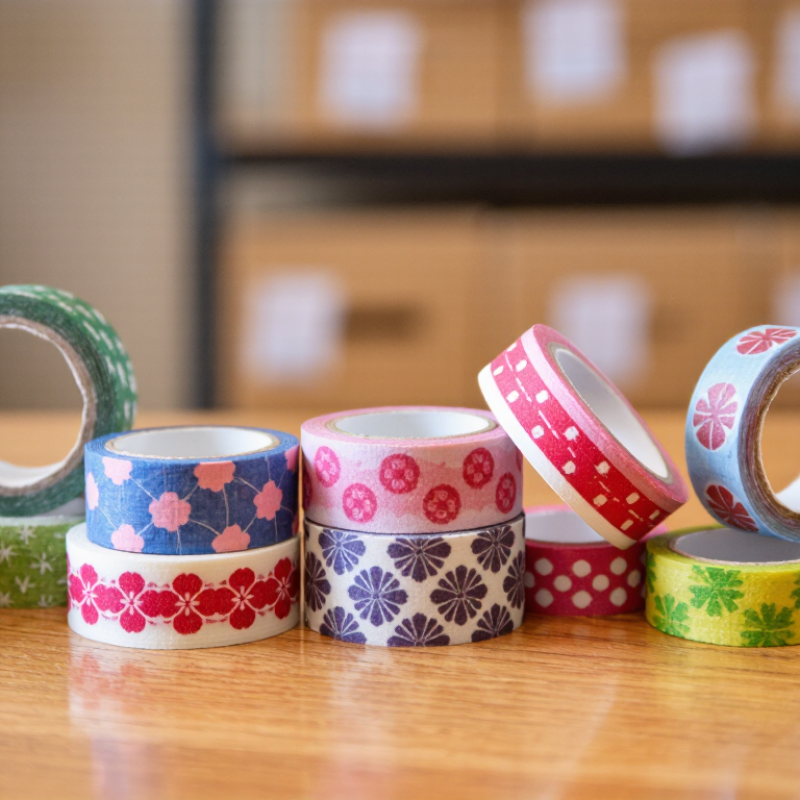
Top Japanese Washi Tape Suppliers for Global Buyers

Washi Tape: Definition, Materials, and Common Global Uses

Washi tape is a lightweight decorative adhesive tape made from Japanese-style paper. Traditional washi uses fibers from plants such as kozo, mitsumata, or gampi. These fibers create a soft texture and gentle translucency. Modern products may blend paper with synthetic fibers for improved strength. It tears easily by hand. That small detail matters during crafting and packaging work.

For global buyers, material quality deserves careful checking. Ask suppliers about paper content, adhesive type, roll dimensions, and storage conditions. Water-based adhesives often support clean removal from smooth surfaces, but performance can change with heat, dust, or humidity. A sample test is more reliable than a catalog photograph. Print sharpness can also vary across textured paper. This is easy to overlook.

Common uses include scrapbooking, gift wrapping, journaling, retail decoration, and temporary product labeling. Designers often use narrow rolls for borders and wider rolls for parcel accents. Offices may use removable tape for color coding, although it is not suitable for every wall or document. Some tapes leave residue after long exposure. That assumption can fail. Suppliers serving international buyers should provide consistent specifications, protective packaging, and clear production samples. Buyers should also verify carton strength before placing large orders. A beautiful roll can still arrive crushed.

Key Criteria for Evaluating Japanese Washi Tape Suppliers

Top Japanese Washi Tape Suppliers for Global Buyers

Key Criteria for Evaluating Japanese Washi Tape Suppliers

Global buyers should judge Japanese washi tape suppliers by evidence, not attractive packaging. Start with material details: paper fiber, tape width, adhesive type, and coating. Ask whether colors remain stable after sunlight, humidity, and ordinary handling. Request samples from different production lots. One sample proves little. Check edge cutting, unwind smoothness, print alignment, and residue after removal. Peel it from glass, cardboard, and painted paper. Small tests expose practical weaknesses.

Reliable suppliers explain their testing methods and share clear technical sheets. Independent laboratory reports can strengthen confidence, but vague certificates deserve questions. Standards vary by market. Do not treat a logo or certificate image as complete proof. Production capacity matters too. Review minimum order quantities, sample fees, lead times, packaging, and shipping terms. Ask how defects are recorded and corrected. Traceability is useful when several rolls arrive with uneven adhesion. Communication is part of quality. Replies should be specific, dated, and consistent. Still, no supplier is perfect. A careful buyer should document assumptions and revisit them after the first shipment.

Tips: Keep a comparison sheet for every supplier. Record sample results, quoted terms, and unanswered questions. Test storage conditions before placing a large order. Humidity may change performance. That detail is easy to miss. Expect adjustments after the first shipment, and treat them as evidence for improving future purchasing decisions.

Leading Japanese Washi Tape Supplier Categories for Overseas Buyers

Overseas buyers usually encounter four Japanese washi tape supplier categories. Each serves a different purchasing situation. Direct manufacturers suit large orders and stable specifications. Export wholesalers offer mixed designs, lower commitment, and simpler shipping. Private-label converters can adjust packaging, widths, printing, and carton quantities. Small craft studios often provide distinctive textures and limited seasonal patterns.

From my sourcing experience, buyers should compare more than catalog appearance. Ask about paper weight, adhesive performance, roll length, core size, and moisture resistance. Request physical samples before approving a production order. Reliable suppliers can explain minimum order quantities, lead times, packaging methods, and export documents clearly. Check whether product descriptions match sample measurements. Do not rely on photos alone. Details matter.

The right category depends on the project. Large stationery programs may need direct factory coordination and repeatable color control. Independent retailers may prefer wholesalers with varied cartons and flexible quantities. Custom gift projects can benefit from converters, although artwork approval may take longer than expected. I have sometimes underestimated packaging space during early sourcing tests. That mistake increased freight costs. Buyers should measure finished cartons and confirm outer-case labels before payment. A thoughtful supplier will discuss these practical issues, not only the tape design.

Ordering, Customization, Pricing, and Export Considerations

Top Japanese Washi Tape Suppliers for Global Buyers

Ordering custom washi tape requires more than choosing a pattern. Ask suppliers for paper weight, adhesive type, roll length, core size, and application temperature. Request a physical sample before approving production. Colors may shift between digital proofs and printed rolls. That small gap matters.

Grand View Research valued the global adhesive tapes market at about USD 87.5 billion in 2023, with continued growth expected through 2030. This broader figure includes industrial products, not decorative washi tape. Still, it shows strong demand for specialty adhesives. Custom orders often require a minimum quantity, plate or setup charges, and separate fees for metallic inks, die-cutting, or protective packaging. Compare the full landed cost, not only the factory price. FOB may look cheaper. Freight, insurance, duties, and local taxes can change the result.

Export buyers should confirm carton dimensions, pallet limits, production lead time, and documentation before payment. The International Trade Centre recommends checking HS classification and destination-market requirements through current customs databases. Paper-based tape can fall under different classifications, depending on construction and use. Ask for material declarations and test records where needed. JETRO’s export guidance also emphasizes accurate commercial invoices, packing lists, and origin information. I would not rely on a supplier’s old template. Rules and freight costs move quickly. A written specification, approved sample, and staged inspection reduce avoidable disputes. Mistakes still happen. Careful buyers plan for them.

Top Japanese Washi Tape Suppliers for Global Buyers - Ordering, Customization, Pricing, and Export Considerations

Supplier Category Typical Product Focus Common Tape Specifications Indicative MOQ Customization Options Indicative Factory Lead Time Indicative Export Price Key Export Considerations
Traditional washi paper producer Handcrafted or small-batch decorative tape using traditional Japanese paper Usually 10–30 mm wide; textured paper; removable acrylic adhesive; individually packed rolls Approximately 500–2,000 rolls per design Paper texture, color, width, length, label, sleeve, and gift packaging; custom printing may be limited 6–12 weeks, depending on paper production and season About US$0.80–US$3.50 per roll, usually FOB or EXW Higher unit cost, limited production capacity, and possible variation in handmade texture or color
Specialty decorative tape converter Printed masking tape for stationery, journaling, craft, and gift applications Commonly 15 mm wide and 5–10 m long; matte or semi-matte finish; paper-based backing Approximately 1,000–5,000 rolls per design Full-color artwork, repeat length, die-cut labels, cores, outer wrap, barcode, and carton marks 4–8 weeks after artwork approval About US$0.35–US$1.20 per roll for standard custom production Confirm color proofing, repeat alignment, adhesive performance, and packaging regulations before mass production
High-volume paper tape manufacturer Retail-ready custom tape collections and private-label programs 15–50 mm widths; 5–20 m lengths; machine-coated adhesive; multi-roll sets available Approximately 5,000–20,000 rolls per design or production run Artwork, dimensions, adhesive grade, print finish, multipacks, retail cartons, inserts, and shipping labels 5–10 weeks, including printing and assembly About US$0.18–US$0.65 per roll at larger volumes Best suited to established demand; buyers should verify carton quantity, pallet configuration, and production tolerances
Small-batch custom print supplier Limited-edition designs for artists, museums, boutiques, and online stores Typically 15 mm wide and 5–10 m long; standard paper stock; individually wrapped Approximately 100–500 rolls per design, subject to printing method Digital artwork, basic packaging, small color changes, and short-run label customization 3–6 weeks after sample approval About US$0.90–US$2.50 per roll, excluding setup and freight charges Higher price per roll; check whether sampling, plate, artwork, and inspection fees are charged separately
Washi masking tape producer Painting, interior finishing, packaging, and light industrial masking applications 18–50 mm widths; longer rolls; higher adhesion options; plain or lightly printed surfaces Approximately 2,000–10,000 rolls per specification Width, length, adhesive strength, backing thickness, core size, carton printing, and private labeling 4–8 weeks for standard specifications; longer for adhesive development About US$0.25–US$1.10 per roll, depending on size and adhesive grade Request surface-compatibility tests, residue data, temperature limits, and technical documentation before importing
Gift-set and stationery assembler Curated tape sets, seasonal collections, planner kits, and gift-box assortments Usually 3–10 rolls per set; mixed widths and patterns; paper sleeve or folding carton Approximately 500–3,000 sets per collection Set composition, artwork, carton dimensions, inserts, stickers, barcode labels, and seasonal packaging 6–10 weeks, including component sourcing and assembly About US$2.50–US$9.00 per set, depending on roll count and packaging Confirm itemized packing lists, retail barcode requirements, carton drop-test needs, and import labeling rules
Export-oriented contract manufacturer Large international orders requiring documentation, quality control, and scheduled shipments Specifications negotiated by buyer; usually standard paper tape formats with customized packaging Approximately 10,000–50,000 rolls per purchase order Artwork management, inspection standards, master cartons, pallets, container loading, and documentation support 6–12 weeks, depending on capacity and order complexity About US$0.15–US$0.70 per roll for standard products at scale Agree on Incoterms, inspection points, product tolerances, payment milestones, and certificate requirements in writing
Buyer Note: Price ranges are indicative wholesale estimates for planning purposes only. Final quotations vary according to paper grade, adhesive specification, printing method, artwork preparation, order volume, packaging, inspection, exchange rates, freight, and Incoterms. Buyers should request a pre-production sample, product specification sheet, packing list, commercial invoice, and applicable export documents before placing a bulk order.

Quality Checks, Certifications, and International Shipping Practices

Reliable Japanese washi tape suppliers should welcome detailed quality checks. Ask for samples from the actual production batch. Examine paper texture, edge cutting, adhesive consistency, and print sharpness. Test the tape on glass, cardboard, and painted surfaces. Record residue, peeling time, and color changes after exposure to light. Small variations can matter in retail packaging.

Request batch records, material specifications, and test reports before placing a large order. Relevant certifications may include forest-management, quality-management, or chemical-safety documentation. However, a certificate alone proves little. Check its issuer, validity, scope, and connection to the supplied product. Suppliers should also explain their inspection frequency and corrective-action process. I have found that clear answers often reveal more than polished brochures. Some suppliers may provide incomplete data. That is a reason to pause, not guess.

Tips: Confirm roll length, core size, carton strength, and moisture protection. Ask for pre-shipment photos and an independent inspection option. For international shipping, agree on Incoterms, delivery responsibility, customs documents, and the correct product classification. Use sealed cartons with internal cushioning, especially during humid seasons. Request a commercial invoice, packing list, origin information, and tracking details. Delivery estimates can change. Build a realistic buffer. A cheaper freight quote may exclude local charges, causing unpleasant surprises at arrival.

This buyer-oriented checklist summarizes the evidence commonly reviewed when evaluating Japanese washi tape suppliers for export. Quality checks cover paper, adhesive, printing, dimensions, and packaging. Certification and compliance checks may include ISO 9001, FSC or PEFC chain of custody, REACH, and RoHS where applicable. Export readiness includes commercial invoices, packing lists, HS classification, country-of-origin information, and transport packaging requirements.

The values represent the number of verification items in each purchasing category, not company scores or market-share data.

FAQS

What is washi tape made from?

Traditional washi uses plant fibers from kozo, mitsumata, or gampi. Modern versions may include synthetic fibers. The texture feels soft.

Why is hand-tearing useful?

Washi tape tears easily without scissors. This helps with journaling, wrapping, borders, and quick packaging adjustments. The tear may not always look perfectly straight.

How can buyers check material quality?

Ask about paper content, adhesive type, roll size, coating, and storage conditions. Request physical samples. Catalog photos can hide paper texture.

Does washi tape remove cleanly from surfaces?

Water-based adhesives often remove cleanly from smooth surfaces. Heat, dust, humidity, and long exposure can change performance. Test glass first.

Which surfaces should buyers test?

Test the tape on glass, cardboard, and painted paper. Check removal, residue, edge lifting, and surface damage. One surface proves little.

What are common uses for washi tape?

People use it for scrapbooks, gift wrapping, journals, retail decoration, and temporary labels. Narrow rolls create borders. Wider rolls decorate parcels.

What should buyers inspect in samples?

Check print alignment, color stability, edge cutting, unwind smoothness, and adhesive consistency. Test samples from different production lots. One roll can mislead you.

What supplier information matters before a large order?

Review minimum order quantities, sample fees, lead times, packaging, carton strength, and shipping terms. Ask how defects are recorded and corrected. Details matter.

How should buyers compare suppliers?

Keep a comparison sheet with test results, prices, unanswered questions, and delivery promises. Specific, dated replies build confidence. Still, no supplier is perfect.

Can storage conditions affect washi tape?

Yes. Humidity may change adhesion and handling. Store samples under expected conditions before ordering. My first assumption may be wrong. Recheck after delivery.

Conclusion

Japanese Washi Tape is a decorative and functional adhesive tape traditionally made from Japanese paper fibers, offering a lightweight texture, easy tearability, and a wide range of colors and patterns. Global buyers use it for stationery, gift wrapping, scrapbooking, packaging, crafts, interior decoration, and creative marketing projects. When evaluating suppliers, buyers should consider material quality, adhesive performance, design consistency, production capacity, communication efficiency, and experience with international orders.

Japanese Washi Tape suppliers may include manufacturers, customized production facilities, wholesale distributors, and specialty exporters. Buyers should clarify minimum order quantities, sampling procedures, customization options, packaging requirements, lead times, and pricing structures before placing an order. Quality checks should cover print accuracy, roll dimensions, adhesion, surface finish, and packaging durability. Reliable suppliers should also provide clear product information, appropriate certifications when required, accurate export documents, and practical international shipping arrangements to support smooth and compliant delivery.

Oliver

Oliver

Oliver is a professional marketing specialist dedicated to helping customers better understand the value, applications, and practical benefits of the company’s products. With a strong background in market research, content strategy, and customer communication, he combines industry knowledge with a......